
SYNTHEMA Symposium on Synthetic Data in Medicine
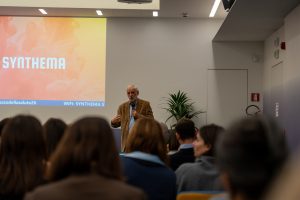
On 3 November 2026, the SYNTHEMA Symposium took place at Palazzo della Salute – MUSME in Padua, Italy. Under the theme Building on Real-World Data: Federated Learning, Synthetic Data and the Future of Data-driven Medicine, the event presented the research carried out over four years of SYNTHEMA, from clinical data collection and synthetic patient generation to federated computing, privacy and responsible AI.
The programme addressed the practical difficulties of studying rare haematological diseases, the technologies developed to work with distributed clinical data, and the conditions under which synthetic data can be trusted and used in medical research.





From rare-disease research to synthetic patient cohorts
The symposium began with Session I – Setting the Scene: From Rare-Disease Data to Federated Research.
María del Mar Mañú Pereira examined the difficulties of collecting reliable clinical data across European rare-disease networks, while SYNTHEMA coordinator Federico Álvarez explained how the project connects clinical centres, data and technical expertise. Both presentations stressed the importance of representative, high-quality data as the starting point for meaningful research.
Session II – From Distributed Real-World Data to Synthetic Data Generation focused on the project’s two clinical use cases.
Matteo Della Porta and Raffaella Colombatti presented the work on acute myeloid leukaemia and sickle cell disease, respectively. Andoni Beristain and Imanol Isasa Reinoso discussed the generation of synthetic patient cohorts from tabular data, followed by Riccardo Biondi and Silvia Valeggia on synthetic MRI. Eleonora Iascone and Sara Reidel addressed data collection and clinical validation in a multicentre setting.
The presentations examined how different types of clinical information can be used to generate synthetic data, alongside the requirements for assessing their quality, representativeness and potential research applications.
Watch the symposium – Part 1
From technical implementation to trust and responsibility
The second part of the programme opened with a keynote by Patrizia Ecker from the Technical University of Munich, Trust, Responsibility and Human Values in the Age of Artificial Intelligence. Her presentation examined accountability, fairness and patient representation in AI-generated data, arguing that trust must be supported by evidence rather than assumed.
Session III – Making Distributed Computation Work turned to the infrastructure behind SYNTHEMA. Petros-Sozon Dimitrakopoulos presented the federated platform and its privacy-preserving architecture, while Giacomo Baruzzo and Sandro Savino shared their experience of establishing local federated computing nodes at the University of Padua.
Session IV – Responsible Health Data-Driven Research examined the privacy and governance requirements of health data technologies.
Rudolf Mayer and Daniela Martinez Duarte discussed de-identification, synthetic data generation and privacy testing, while Nathan Lea addressed trust, governance and responsibility in health data research.
The session concluded with the panel discussion Can We Trust Synthetic Data?, featuring Gastone Castellani, Rudolf Mayer and Nathan Lea. The discussion considered the reliability of synthetic data, the importance of validation and the responsibilities involved in applying these technologies to research and clinical decision-making.
The symposium closed with reflections from Raffaella Colombatti, María del Mar Mañú Pereira and Federico Álvarez on future collaboration between medicine, engineering and AI.
Watch the symposium – Part 2
The discussions in Padua reflected both the progress made during SYNTHEMA and the work that remains. Generating synthetic data is one part of the process. Ensuring that these data are representative, clinically useful and adequately protected requires continued research, technical validation and cooperation across disciplines.